Paddling focused buyer guide
Kayak vs. Paddleboard: Which Is Right for You?
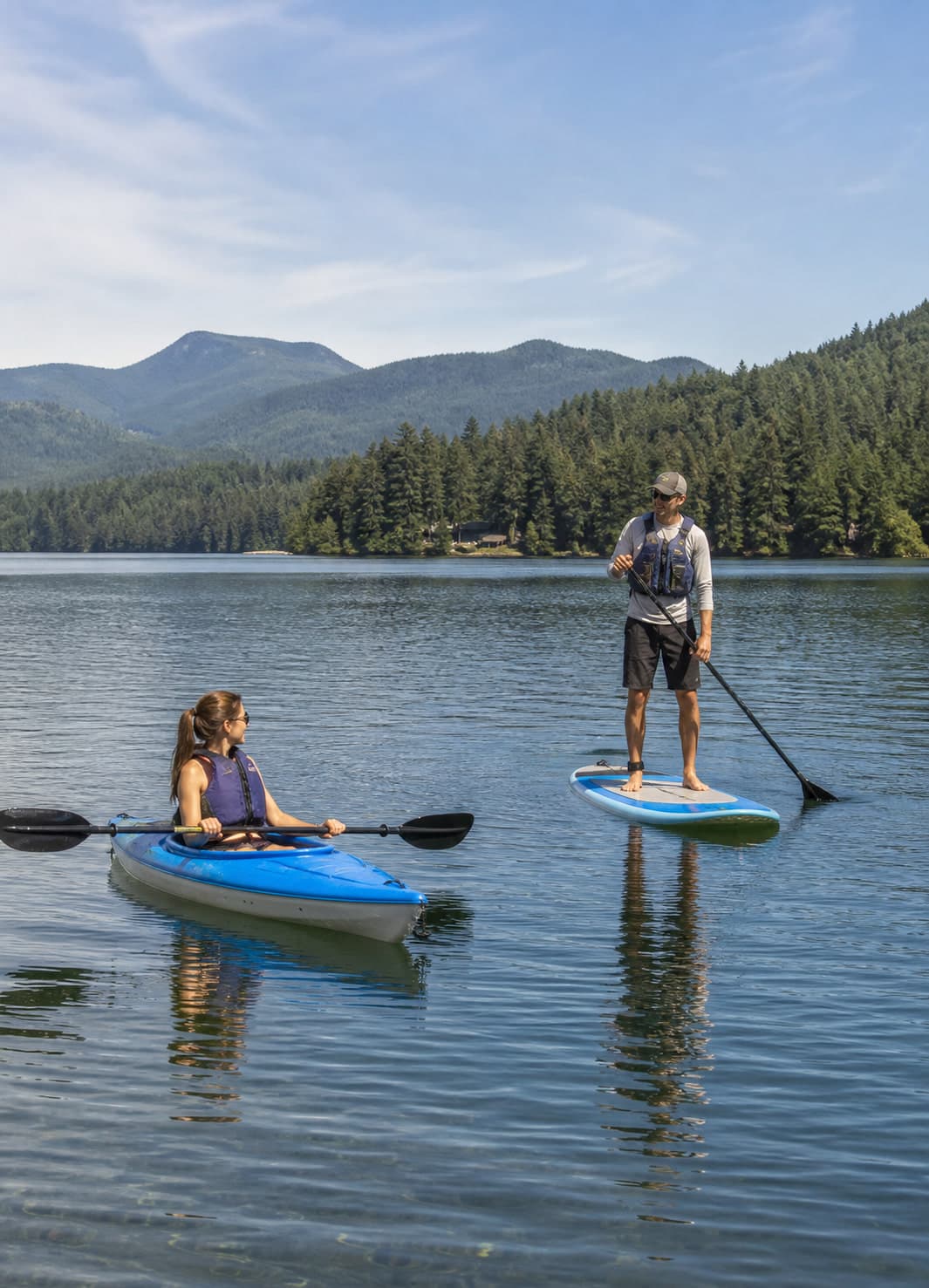
Kayaks and paddleboards can both work well on calm, protected water, but they feel very different in wind, cold water, waves, and longer outings. The better choice is the one that matches your balance, transport limits, comfort preferences, and intended water conditions.
Compare all paddling gear →Quick answer
The practical starting point
Choose a recreational kayak when seated comfort, stability, cooler conditions, and carrying capacity matter most. Choose a wide all-around paddleboard when simple transport, warm-water recreation, fitness, and the option to stand or kneel matter more.
Before comparing models
Buyer Checklist
Use these requirements to remove unsuitable options before price or brand becomes the deciding factor.
- 01
Choose the water and weather conditions before choosing the craft.
- 02
Wear a properly fitted personal flotation device for every outing.
- 03
Consider cold-water immersion even when the air feels warm.
- 04
Compare loaded transport weight, not only the advertised hull weight.
- 05
Plan how the craft will be stored, secured, launched, and dried.
- 06
Check local rules for registration, invasive-species permits, leashes, and required safety equipment.
Side-by-side
Kayak and Paddleboard Differences
This comparison assumes recreational equipment used on calm lakes, slow rivers, and protected coastal water. Performance changes significantly with specialized touring, whitewater, fishing, or surf designs.
| Option | Best for | Strengths | Watch for |
|---|---|---|---|
| Stability and confidence | Kayak | Lower seated position and protected leg contact feel secure | Entry and exit can be awkward for some users |
| Compact transport | Inflatable paddleboard | Packs into a vehicle-friendly bag and stores in small spaces | Requires inflation, drying, and careful fin handling |
| Longer relaxed outings | Kayak | Seated position, back support, and cargo storage | Boat weight and roof loading can be limiting |
| Warm-weather versatility | Paddleboard | Stand, kneel, sit, exercise, or swim from the board | More exposed to wind, falls, and cold water |
Narrow the field
Three Practical Paddling Profiles
These profiles help identify the right category, followed by current product examples. Confirm weight capacity, safety equipment, local rules, transport, and actual water conditions before selecting a model.
Checklist gearKayaks and paddleboards6 researched options
Craft choice matched to stability, transport, and intended water.
Choose by preference
Portable, stable paddleboards
Choose this group for compact storage and warm, protected water. Every option still requires a properly fitted PFD and conservative conditions.
BOTE
WULF Aero
The lower-cost stable inflatable for short warm-water outings when portability matters more than speed or accessories.
- Inflatable Paddleboard
- 10 ft. 4 in.
- 20 lb.
- 250 lb. capacity
Best for
first recreational SUP · small vehicles · protected lakes
Why this pick, watch-outs & evidence
Why we recommend it
- The 34-inch platform is stable and approachable.
- A roughly 20-pound board is manageable off the water.
- The package includes the basic paddle, pump, leash, fin, and bag.
Watch-outs
- The fin mechanism can be unintuitive at first.
- An open paddleboard provides no cold-water protection; dress for immersion and wear a PFD.
Evidence behind this pick
Current specifications and independent hands-on testing support its stability and portability while documenting setup limitations.
Sources reviewed- BOTE: WULF AeroCommercial or manufacturer source
- OutdoorGearLab: BOTE Wulf Aero ReviewIndependent source
Also compare: ISLE Pioneer 3 Paddle Board · BOTE Breeze Aero Inflatable Paddle Board
Editorial review Aug 8, 2026 · Availability checked Aug 8, 2026
ISLE
Pioneer 3 Paddle Board
A wider-use stable platform when deck space and a lighter board matter more than premium accessory rails.
- Inflatable Paddleboard
- 10 ft. 6 in.
- 19 lb.
- 285 lb. capacity
Best for
relaxed all-around paddling · a child or pet within capacity · full-deck use
Why this pick, watch-outs & evidence
Why we recommend it
- The broad deck and full-length traction pad are easy to use.
- The 19-pound board is relatively light for its size.
- The current package includes paddle, pump, leash, fin, and wheeled bag.
Watch-outs
- Manual inflation and the complete bag still require effort.
- It remains a warm, protected-water choice, not cold-water protection.
Evidence behind this pick
Manufacturer specifications and comparative hands-on testing support the stability-and-deck-space case.
Sources reviewed- ISLE: Pioneer 3 Paddle BoardCommercial or manufacturer source
- OutdoorGearLab: ISLE Pioneer 3 ReviewIndependent source
Also compare: BOTE WULF Aero · BOTE Breeze Aero Inflatable Paddle Board
Editorial review Aug 8, 2026 · Availability checked Aug 8, 2026
BOTE
Breeze Aero Inflatable Paddle Board
The feature-rich all-around inflatable for paddlers who will use its attachment system and size choices.
- Inflatable Paddleboard
- 10 ft. 6 in. or 11 ft. 6 in.
- 20 or 22 lb.
- 250 or 315 lb. capacity
Best for
frequent recreational paddling · accessory expansion · choosing capacity by rider and gear
Why this pick, watch-outs & evidence
Why we recommend it
- Two lengths cover different capacity needs.
- The stable platform remains approachable while tracking capably for recreation.
- Accessory mounting adds useful long-term flexibility.
Watch-outs
- The premium price is hard to justify if you will not use the accessory system.
- Wind and cold-water limits still apply regardless of price.
Evidence behind this pick
Current specifications and comparative testing support the balanced handling and feature set.
Sources reviewed- BOTE: Breeze AeroCommercial or manufacturer source
- OutdoorGearLab: BOTE Breeze Aero ReviewIndependent source
Also compare: ISLE Pioneer 3 Paddle Board · BOTE WULF Aero
Editorial review Aug 8, 2026 · Availability checked Aug 8, 2026
Choose by preference
Calm-water sit-in kayaks
Choose by lifting weight, cockpit comfort, and trip length. These are recreational kayaks, not rough-water or open-coast craft.
Pelican
Argo 100X EXO
The lightest and lowest-cost kayak here for short protected-water trips, with basic tracking and outfitting.
- Sit In Kayak
- 10 ft.
- 36 lb.
- 275 lb. capacity
Best for
easy transport · short lake outings · budget-focused recreation
Why this pick, watch-outs & evidence
Why we recommend it
- The 36-pound hull is easier to lift than most hard kayaks.
- Initial stability makes relaxed entry-level use approachable.
- The removable storage module is practical for short trips.
Watch-outs
- Tracking and speed are limited on longer or windier outings.
- The open cockpit still requires immersion clothing, a PFD, and recovery planning in cold water.
Evidence behind this pick
Current specifications and hands-on testing support the transport-and-stability advantage and document the handling limits.
Sources reviewed- Pelican / Confluence Outdoor: Argo 100X EXO Recreational KayakCommercial or manufacturer source
- OutdoorGearLab: Pelican Argo 100X EXO ReviewIndependent source
Also compare: Old Town Vapor 10 · Old Town Loon 120
Editorial review Aug 8, 2026 · Availability checked Aug 8, 2026
Old Town
Vapor 10
The roomy stable middle choice when cockpit comfort matters more than glide, speed, or sealed storage.
- Sit In Kayak
- 10 ft.
- 47 lb.
- 325 lb. total capacity
Best for
larger cockpit preference · relaxed flatwater paddling · short slow-river trips
Why this pick, watch-outs & evidence
Why we recommend it
- The large cockpit simplifies entry and exit.
- The stable hull is predictable for recreational use.
- Old Town's current listing and hull support are clear.
Watch-outs
- It is slower and heavier than the budget kayak.
- Storage is less protected than the Loon's.
Evidence behind this pick
Current product specifications and 2025 hands-on testing support its stability and comfort while documenting speed and storage tradeoffs.
Sources reviewed- Old Town: Vapor 10Commercial or manufacturer source
- OutdoorGearLab: Old Town Vapor 10 ReviewIndependent source
Also compare: Pelican Argo 100X EXO · Old Town Loon 120
Editorial review Aug 8, 2026 · Availability checked Aug 8, 2026
Old Town
Loon 120
The premium choice for longer calm-water outings where seat comfort, glide, and protected storage justify the weight and cost.
- Sit In Kayak
- 12 ft.
- 54 lb.
- 375 lb. capacity
Best for
longer lake outings · cool-weather recreation · paddlers prioritizing seat comfort
Why this pick, watch-outs & evidence
Why we recommend it
- The 12-foot hull improves glide and tracking.
- The seat and cockpit outfitting support longer sessions.
- Protected storage adds useful trip flexibility.
Watch-outs
- The hull is heavier to lift and roof-load.
- The cost is unnecessary for occasional short outings.
- It is still a recreational kayak with conservative water and weather limits.
Evidence behind this pick
Current specifications and independent hands-on testing support the glide, comfort, and storage case with transport costs noted.
Sources reviewed- Old Town: Loon 120Commercial or manufacturer source
- OutdoorGearLab: Old Town Loon 120 ReviewIndependent source
Also compare: Old Town Vapor 10 · Pelican Argo 100X EXO
Editorial review Aug 8, 2026 · Availability checked Aug 8, 2026
Start with Stability and Water Conditions
A recreational kayak keeps the center of gravity low and supports the paddler in a seated position. That usually feels more stable to beginners, particularly when wind or small waves appear.
A wide paddleboard can also be stable, but standing raises the center of gravity and increases exposure to wind. Kneeling lowers the body and is a useful transition position while learning.
Transport Can Decide the Purchase
Rigid kayaks and paddleboards need roof racks, a trailer, a truck bed, or enough interior vehicle length. Their listed weight may seem manageable until lifting above shoulder height or carrying from a distant parking area.
Inflatable paddleboards solve many storage and transport problems, but they require inflation, rinsing, complete drying, and space to handle the board at the launch. A quality pump and a realistic setup routine are part of the ownership experience.
Comfort Changes over Time
Kayaks provide a seated position and often more secure cargo storage. Seat shape, foot-brace adjustment, cockpit fit, and leg movement determine whether that comfort lasts for several hours.
Paddleboards allow frequent position changes and easy access to the water, but feet, knees, and lower back can fatigue. A removable seat can add options, though it does not turn every board into an efficient kayak.
Safety Equipment Is Not Optional
Wear a correctly fitted personal flotation device and carry the required signaling equipment. Dress for the water temperature, not only the air temperature. Cold-water shock can occur quickly and can make an easy swim unexpectedly dangerous.
Wind often makes the return trip harder. Begin by paddling into the wind or current when practical, stay close to shore, and turn around before fatigue becomes a problem. Leash selection depends on the environment; a leash that is useful on open water can create entanglement risk in moving water.
Common questions
Frequently Asked Questions
Is a kayak or paddleboard easier for a beginner?
A wide recreational kayak usually feels easier because the paddler sits lower. A wide paddleboard can still be beginner friendly on calm, warm, protected water, especially when starting from a kneeling position.
Which is easier to transport?
An inflatable paddleboard is usually easiest to store and transport. Rigid paddleboards and kayaks require a larger vehicle solution and safe tie-down system.
Can a paddleboard be used like a kayak?
Many boards accept a seat and can be paddled while sitting. They remain wider, more wind-affected, and generally less efficient than a purpose-built recreational kayak.
Next step
Choose Your Next Step
Use one activity or destination resource to turn the buying research into a practical trip plan.